
INTRODUCTION
Sometime ago Srikanth, a friend on Twitter, written a thread on short history of Madhva community.
In that he mentioned about 'an element of iconoclasm' supposedly committed by Sri Madhvacharya against the murti of Subrahmanya.
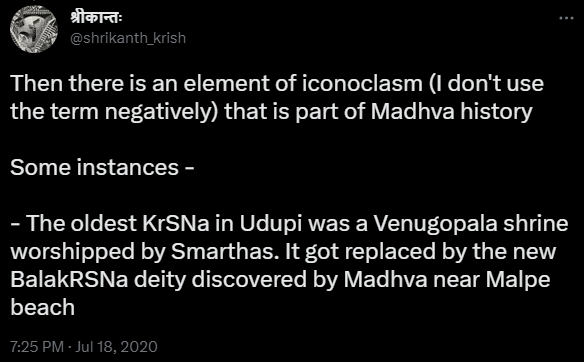
THE SOURCE & ITS ACTUAL CONTENTS:
A book titled "Sri Krishna Temple at Udupi" is the source for Srikantha's observation on 'iconoclasm' committed by Sri Madhvacharya. The undertone of this statement is to view the issue of iconoclasm from the lenses of Shaiva-Vaishnava face-off.
But the fact of the matter is that the very book has made it amply clear that there was no iconoclasm committed by Sri Madhvacharya.
In page nos. 144, 145 & 146 of the said book, the author B.N. Hebbar says-"Subrahmanya icon was removed & thrown."
I feel that the author chose wrong words unintentionally(!).
Let me explain why.
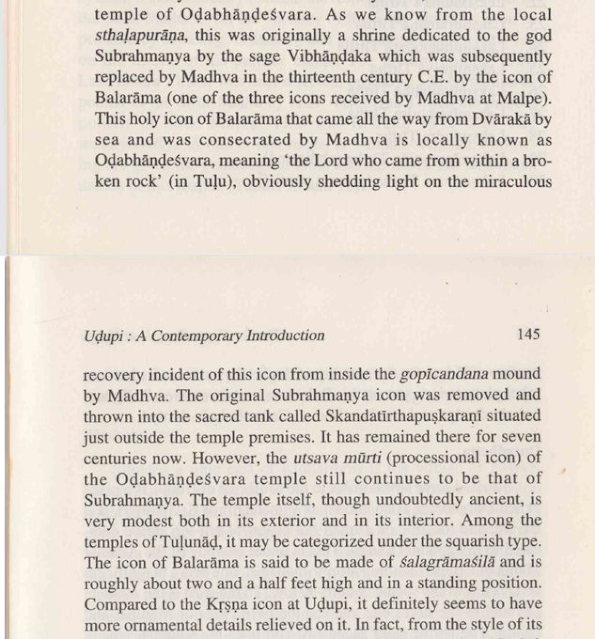
For a reader coming from outside the Madhva fold, the above words can give rise to a speculation that Sri Madhvacharya might have discarded the murti of Subrahmanya to install Balarama which can trigger further speculation that the alleged 'iconoclasm' was committed out of distaste for Shiva and Shiva Parivara.
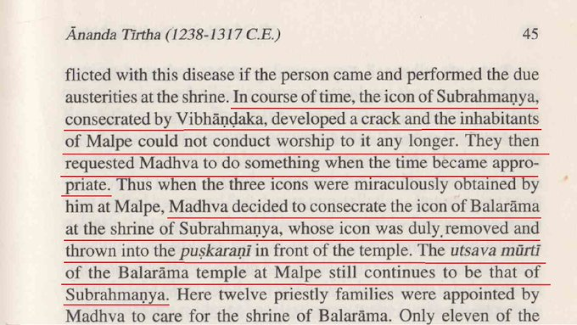
But the same author in page no. 45 says that the murti of Subrahmanya had developed cracks and became unfit for puja. So, the devotees requested the Sri Madhvacharya to do something.
Thus, Sri Madhva carried out the rituals needed for disposing a broken murti.
This is nothing unusual or unexpected. There are such cases from the past and let me present one incident from the life of Sri Ramanujacharya.
PROPER DISPOSAL OF VISHNU'S MURTI BY SRI RAMANUJACHARYA:
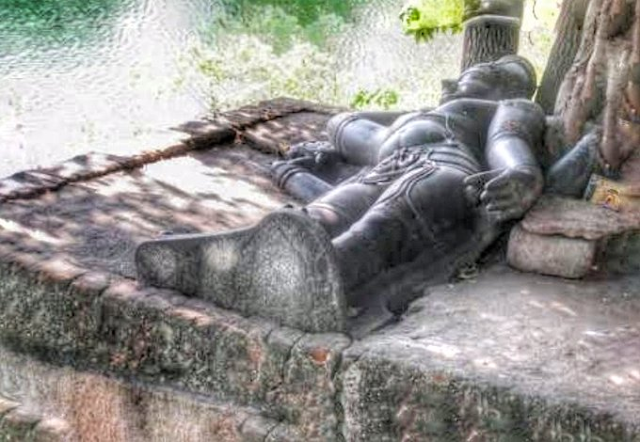
In 12th century AD, the Ranganatha pratima shown in the below image was brought from Chidambaram to Tirupati to get consecrated by Sri Ramanuja. But it was left on the banks of Narasimhatirtha in the holy town of Tirupati on the advise of Sri Ramanuja.
As the murti was broken during transportation from Chidambaram to Tirupati, Sri Ramanujacharya had to dispose it off near a waterbody as recommended by the Agamas.
Thus, it can be safely concluded that there was no iconoclasm by Sri Madhvacharya but Mr. Hebbar's choice of words painted a wrong picture of 'iconoclasm' albeit the word was not used in its original sense.
FURTHER NOTES BY Mr. HEBBAR:
The author also points out in page no. 145 that the biography of Sri Acharya, Madhva Vijaya, has not got any reference to Balarama's consecration. His reference to Sri Vadiraja that he has not laid down rules for this Balarama temple as he did for Krishna Matha is also noteworthy.
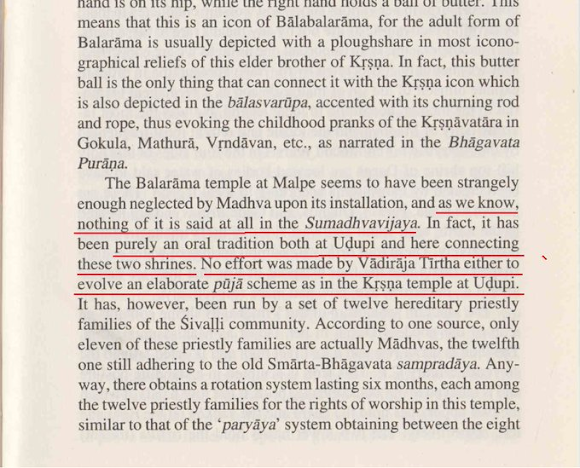
Not only Madhva Vijaya but the Haridasa literature (that I have in my collection) mention Udupi Krishna only but nothing about the consecration of Balarama by Sri Madhvacharya.
SUBRAHMANYA AND SRI MADHVACHARYA
On the other hand, Acharya Madhva places Skanda or Subrahmanya as one of the prominent Devatas to be invoked during Tantra based rituals such as temple construction.
He mentions Skanda being Abhimani for Manas along with Indra. स्कंदॅंद्रौ मन उच्यतॅ (Tantrasara, 3rd Adhyaya, Shloka.134).
Acharya, in 4th Adhyaya of Tantrasara, describes Shiva Panchakshari, Parvati Panchakshari & Skanda mantra.
ADDITIONAL NOTES ON MADHVAS AND DEVOTION TOWARDS SHIVA & HIS PARIVARA:
- Sri Madhva's direct disciple Sri Tivikrama Panditacharya wrote Shiva Stuti.
- Sri Vadiraja, in his Tirtha Prabandha, alongside of writing considerable number shlokas on Shiva, Parvati, Ganapati and Skanda wrote a shloka on Nandi as well. Likewise, Sri Vijayindra Tirtha composed a stotra on Parama Shiva.
- It is needless to say that hundreds of Kannada kirtanas were written by the Haridasas on Shiva & Shiva Parivara.
Thus, one can understand that Acharya Madhva didn't propagate dvesha against Shiva & His family.
Such being the facts, the possibility of "throwing" the very Devata that the Acharya eulogized is not correct.
Sri Madhvacharya didn't throw away Subrahmanya but disposed the broken murti by placing it in the pushkarini.
CONCLUSION
Thus, going by the the book by Mr. Hebbar and also by the literature and books written by Sri Madhvacharya it can be concluded that the purported iconoclasm is not factually correct but a fallacy araising out of a random word by Mr. Hebbar.
May Sri Madhva, the rAjahaMsa roaming in the ocean of Srihari's lIlA sAgara, may bestow the devotees with knowledge and lead on to the path of Mukti.

Comments
Post a Comment